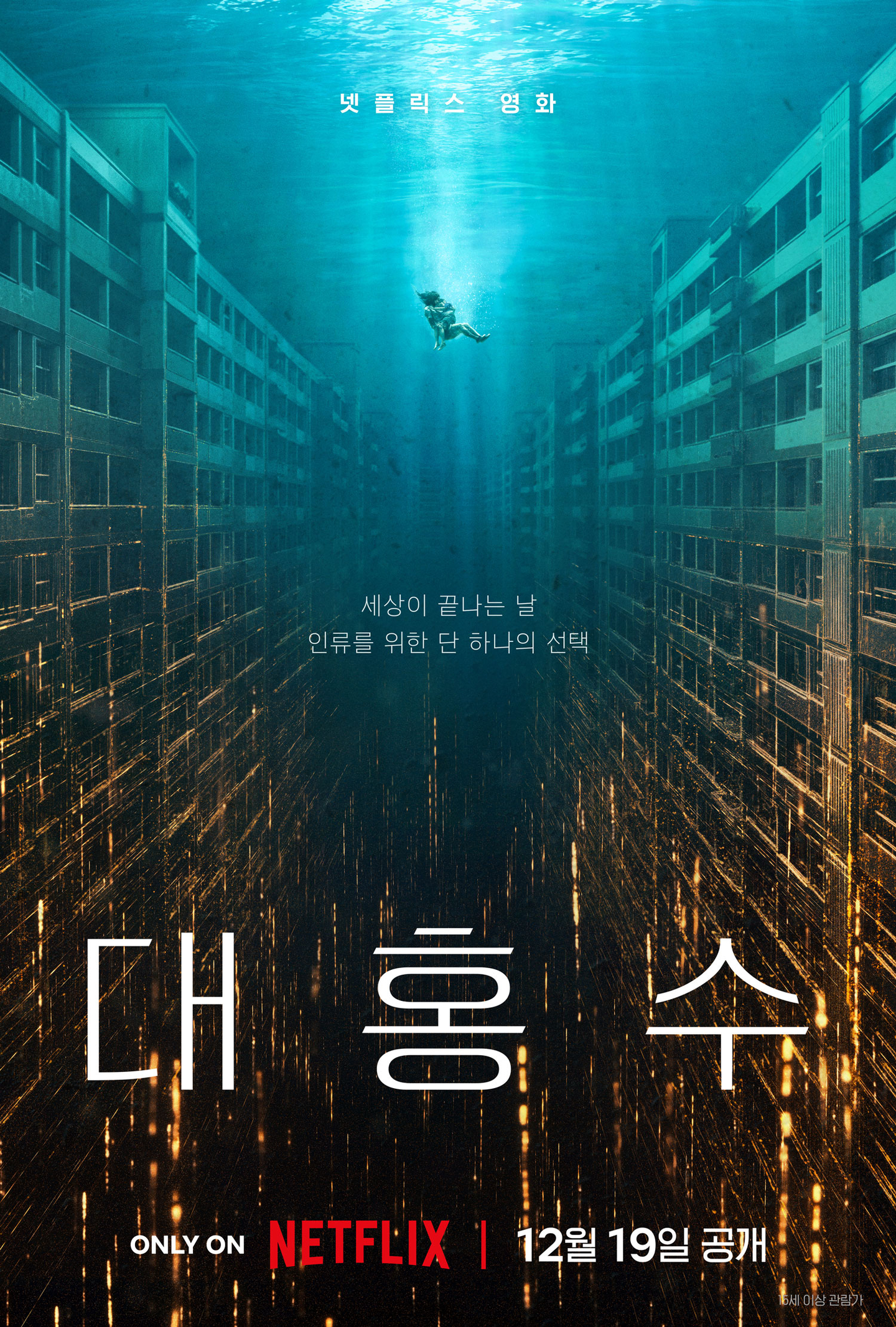
The Great Flood (대홍수)
Written by Kim Byung-woo and Han Ji-su & Directed by Kim Byung-woo
Production company Hwansang Studios
How do we save our humanity when our future is increasingly shaped by artificial intelligence?
That question quietly rises to the surface while watching The Great Flood. It does not arrive as a declaration, but as a feeling that lingers long after the screen fades to black. Beneath the spectacle and urgency of a world submerged, the film seems less interested in catastrophe itself and more invested in what remains human when everything familiar is stripped away.
At its core, the film meditates on emotion, not as something ornamental or secondary, but as something essential. Love, care, and the willingness to choose another over oneself feel like the true currency of survival here. If something is to come after humanity, even if shaped or guided by artificial intelligence, the film suggests that emotion may be the one thing worth carrying forward. I left the film with a quiet thought echoing inside me: perhaps the most radical instruction it offers is simple. Listen to your heart.
Visually, it is striking. The scale of water, confinement, and movement creates an immersive experience that feels both overwhelming and intimate. There are moments that evoke the intricate memory games of Memento and the emotional vastness of Interstellar, not in imitation, but in spirit. The ambition is evident. This is a film unafraid to blend disaster cinema with reflective science fiction, trusting the audience to sit with questions rather than rush toward answers.
What I appreciated most is how the film frames the tension between artificial intelligence and human emotion. Can something created learn to feel, or only to simulate feeling? And if the difference matters, why does it matter? The film does not lecture. Instead, it places emotion at the centre and lets us observe what happens when logic alone is not enough.
Survival here is not only about staying alive. It becomes a moral and emotional inquiry: What are we truly trying to preserve? Is it life in its most basic sense, or the emotional essence that gives life meaning? In moments of crisis, the film gently reminds us that efficiency and calculation cannot replace compassion, attachment, and presence.
Motherhood emerges as a quiet yet powerful anchor, not as an idealized concept, but as a lived, emotional reality rooted in responsibility, love, and endurance. The bond between parent and child becomes a lens through which the film explores meaning, purpose, and continuity. In a world facing extinction, attachment is not portrayed as weakness. It is portrayed as direction.
This production may divide audiences in its structure and ambition, but its heart feels sincere. It asks us to consider a future shaped by technology without surrendering the emotional truths that define us. It reminds us that progress without feeling is hollow, and that humanity is not only something we are born with, but something we must continually choose.
In the end, the flood is not only water. It is a test of memory, of love, and of what we decide is worth saving.
Image courtesy of Netflix
Comments are closed.